If You Didn't Fertilize in May, You're Not Behind — But Your Window Just Changed
It's mid-June. Your lawn is fully greened up, the heat is settling in, and you're standing in the driveway noticing it looks a little tired. Maybe a little yellow in spots. Your neighbor mentioned a spring feeding back in May, and now you're wondering if you missed the boat.
You didn't. But the decision in front of you isn't the same one you'd have made three weeks ago, and the wrong move right now is worse than doing nothing.
We want to walk you through what May was supposed to do for your lawn, what mid-June actually calls for instead, and why the bag of "summer lawn food" at the big-box store is probably the wrong answer no matter when you put it down — because of something specific about the dirt under your feet here in DFW.
What May Was Supposed to Do
A pre-summer feeding pushes root development before the heat clamps down and builds the carbohydrate reserves your lawn will burn through in July and August. Those reserves are also what carries the lawn through the back end of summer when pest and disease pressure peaks — a well-fed-but-not-overfed lawn handles stress better than a hungry one or an overfed one.
Species matter here. Bermuda is the big nitrogen responder — it can take a real feeding and put it to work. Zoysia is the opposite: slow grower, low nitrogen needs, easy to over-push. St. Augustine sits in the middle and gets into trouble fast when you overdo it. Too much nitrogen on St. Augustine is how you grow a chinch bug buffet.
If you missed May, your lawn isn't ruined. It just means the next decision matters more, not less.
Why Alkaline Soil Changes the Math
This is the piece almost nobody at the garden center tells you.
Most DFW soils run a pH between 7.5 and 8.5. Black clay through Collin and Dallas counties. Clay loam across most of the metro. Caliche pockets in parts of Denton and Tarrant. Not every yard — if you're on sandy loam, this section changes for you, and that's worth confirming before you assume.
At that pH, something specific happens: iron and manganese get chemically locked up in the soil. They're physically there. Your lawn just can't pull them in.
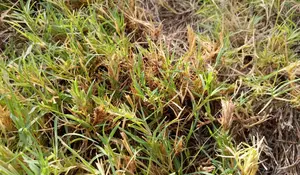
Here's how that plays out in real yards. The lawn starts looking yellow. You read it as hunger and put down a high-nitrogen bag. The nitrogen pushes top growth, but the locked-up micronutrients can't keep up with that growth — so the yellow gets worse, not better. You're feeding a problem you can't fix with feeding.
That yellowing is iron chlorosis. It's the single most-misdiagnosed condition we see in DFW lawns. The only honest way to know what your soil is actually doing is to test it. Texas A&M AgriLife runs a routine soil test through your county extension office for about twelve dollars. Almost nobody uses it. It's the cheapest piece of real information you can buy for your lawn.
What to Apply in Mid-June
The species breakdown for right now:
Bermuda. If it hasn't had a feeding yet this season, a moderate nitrogen application is still appropriate this month. If the color is off despite good growth, pair it with iron — the iron does the work the nitrogen can't do on alkaline soil.
St. Augustine. Light touch. Watch the nitrogen carefully. If you're seeing yellow and growth looks normal, iron alone is usually the better answer than another shot of N.
Zoysia. You're probably done feeding until fall. Zoysia doesn't want to be pushed in summer, and a heavy summer push can set up the soft, lush growth that large patch moves into during the fall transition.
The other piece nobody mentions: watering granular fertilizer in. On alkaline clay, this step trips a lot of homeowners up. Over-water and the granules run off the crowns and pile in the low spots. Under-water and they sit on the surface and burn the blades. Time the application to the day before one of your twice-weekly watering days, or hand-water it in lightly right after.
What to Hold Until Fall
This is the discipline part. Heavy nitrogen from late June through August is exactly how DFW lawns end up with gray leaf spot covering the St. Augustine in July, and chinch bug damage in August that won't quit no matter how much you water. Excess nitrogen is a direct trigger for gray leaf spot and an aggravator for chinch bug — feeding hard right now isn't neutral, it's a thumb on the scale toward both problems.
The real lawn-building fertilization window for warm-season grass in DFW is September into October. That's when your lawn pulls carbohydrate reserves down into the crown and roots for winter — and after the colder, longer winters we've had the last several years, those reserves matter more than ever. Hold the nitrogen now.
Where This Goes Sideways
Two mistakes we see over and over.
The wrong bag. Generic "summer lawn food" from national brands isn't formulated with DFW's alkaline pH in mind. The nitrogen still works. The iron and micronutrients on the label often don't, because plant availability on a 7.5–8.5 soil isn't what the label assumes. You're paying for nutrients your lawn can't fully use.
Foundation-watering overlap. If you're running soaker hoses around the foundation to keep black clay from shrinking and cracking — and you should be, if that's your soil — you've got a chronically wet 1–3 foot perimeter where any fertilizer you apply gets diluted, leached past the roots, or feeds the fungal disease those wet zones already favor. The rest of the lawn stays hungry. We see this pattern constantly.
There are other ways this goes sideways — new construction lawns sitting on 2–4 inches of topsoil over compacted clay respond to fertilizer completely differently and usually need their own conversation — but we diagnose the rest on the visit.
How We Handle Mid-Season Fertilization
Our programs are built around DFW's alkaline-soil reality. We aren't handing your lawn the same bag a Georgia or Florida program would put down, because it wouldn't work the same way here.
On a mid-season visit, we read your lawn's current state, factor in the species, factor in your city's watering restriction schedule, factor in foundation-watering zones if we can see them, and adjust the application to match. Not a calendar formula — a read of what's in front of us.
If you're looking at yellow patches right now and you don't know whether you're seeing hunger, iron, or something else entirely, that's the kind of call we'd rather take a look at than guess at from your driveway. Everything in this post is doable on your own if you want it to be. We just make it the easy choice instead of the Saturday project.