Bermudagrass Stunt Mite Is Showing Up in DFW Lawns Right Now — Here's the Hand-Lens Test That Confirms It
Seeing tufted, broom-like patches in your DFW Bermuda lawn this June? Here's the $10 hand-lens test that confirms bermudagrass stunt mite — and what to do next.
The Bermuda Patch That Won't Mow Flat
You mowed Tuesday. By Friday, there's a patch out front that looks like it never got cut.
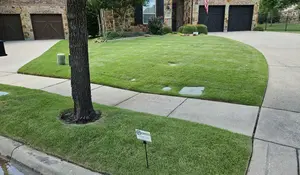
It's not the whole lawn — just a section, maybe along the sunny edge by the driveway or out near the curb. The Bermuda there looks bunched up. Tufted. A little off-color. Almost like a cowlick the mower skipped.
You watered. Nothing changed. You threw down some fertilizer two weeks ago, and if anything the patch looks worse. Now it's spreading.
Our techs flagged three of these on Bermuda lawns this week — Frisco, Plano, west Fort Worth. The conditions line up: stretches of 90°F-plus heat, no real rain, lawns running dry. That combination is when this particular problem shows up on schedule.
It's almost certainly bermudagrass stunt mite. And the test to confirm it costs about ten bucks.
What's Actually Going On Down There
Bermudagrass stunt mite is a microscopic mite that lives under the leaf sheath of your Bermuda. You can't see it with your naked eye. Not even close.
What it does is simple. It feeds in the tight space where the leaf wraps the stem, and that feeding shortens the internodes — the gaps between leaf nodes on a stolon. The stem stops elongating. The leaves keep stacking up at the tip.
That's the tufted, broom-like look you're staring at. The mite isn't eating the lawn. It's shrinking the stem until the canopy can't function.
Bermuda only. Zoysia and St. Augustine aren't on the menu, so if you have a mixed lawn, you'll see this only in the Bermuda sections.
It loves hot and dry. May through September is the window, and right now we're sitting in the sweet spot — sustained heat, no meaningful rain, lawns under stress.
Because you can't see the mite without magnification, this gets misdiagnosed for weeks. People water more. Fertilize more. Spray things. The patch keeps spreading.
Rule Out the Look-Alikes First
Before you call it stunt mite, walk through what it isn't.
Scalping follows your mow lines — straight, symmetric, worse on the high spots. The individual stems aren't tufted. Stunt mite doesn't care about mow lines.
Drought stress shows up across the whole area. Footprints stay pressed down. A deep watering brings it back in a day or two. Stunt mite damage doesn't respond to water.
Herbicide drift has sharp, clean edges — usually along a property line, a driveway, or the path a neighbor's sprayer took. Stunt mite damage has a soft, irregular border.
Iron chlorosis is the most common misdiagnosis of anything on our alkaline DFW soils. It's a uniform yellow across whole leaves, top to bottom. Not tufted. Not bunched.
Rhodesgrass mealybug also hits stressed summer Bermuda, but the cottony white masses at the nodes are visible without any magnification. White fuzz on the stems means it's not stunt mite.
Spring dead spot is circular dead patches that show up at green-up in March and April. Not a June problem.
The fingerprint of stunt mite is the shortened internodes and the rosetted, broomed-out tips. If you find that, you've found it.
The Hand-Lens Test, Step by Step
Here's how to confirm it yourself.
Get a 10x hand lens. Hardware store, Amazon, ten bucks. A phone macro lens works in a pinch.
Go out mid-morning, after the dew is off. Find the edge of the suspect patch — not the worst-looking center, but the transition zone where healthy Bermuda meets the tufted stuff. That's where you'll see the cleanest comparison.
Pull up a single stolon. Lift one of the runners and pick a node — one of the joints along the stem. Gently peel back the leaf sheath at the node.
Look for three things. First, shortened, stacked internodes — the gaps between nodes should be short and bunched compared to a healthy stolon. That's the giveaway. Second, rosetted, broom-like growth at the tip, leaves fanning out from one tight point instead of spaced along the stem. Third, tiny white-to-translucent worm-shaped mites under the sheath. You may or may not actually see those — they sit right at the edge of what 10x can resolve. Don't worry if you can't pick them out.
Be honest about what you're seeing. The tufting pattern is the most reliable home diagnostic. Confirming the mites themselves usually takes a microscope. If the shortened internodes and rosetting are there, that's enough to act on.
Where It Goes Sideways for DIY
A few honest warnings, because the same mistakes show up every summer.
Don't spray it before you've confirmed it. Stunt mite lives under the leaf sheath, and most contact products designed for surface mites largely miss the target. You'll spend money and watch the patch keep spreading.
Don't mow it without bagging. Cutting through the affected area and then running across the healthy lawn spreads mites on the deck and tires into clean turf. Bag the affected section. Run a separate pass.
Don't crank the nitrogen. The instinct is to feed the lawn out of trouble, but extra nitrogen actually feeds the tufting and puts more stress on already-stressed Bermuda in summer heat. It makes the problem worse.
And don't shrug it off because it's small. Under the conditions we're sitting in — hot, dry, nothing meaningful on the ten-day forecast — a patch the size of a doormat in June becomes a quarter of your front yard by late July. The trajectory is the part most homeowners miss.
How We Handle It
When you bring us in on a stunt mite call, we confirm it with proper magnification first — not a guess from the driveway.
From there, the treatment falls in a category that requires a licensed applicator, so it's not a walk-through-the-aisle-at-the-big-box situation. What we pair with the application matters as much as the application itself: bagging and cleaning protocols on the mowing side so we're not spreading it, lighter nitrogen until the canopy starts pushing recovery growth, and a deep-and-infrequent watering pattern that works inside the twice-weekly schedule your city allows.
Our crews are running this play on Bermuda lawns across DFW right now. The conditions told us a month ago it was coming.
Your Next Step
If you ran the hand-lens test and the tufting is there, don't wait through July to see how bad it gets. By then we're treating a much bigger area on heat-stressed turf — harder on the lawn, harder on your budget.
Grab a free quote and we'll come confirm it and get a plan together.
Missed May fertilization? Mid-June still has a real call to make on your DFW lawn — and alkaline soil changes which bag actually works. Here's what to do now.
A lush, green lawn enhances the beauty of any landscape, providing a perfect space for relaxation and activities. However, maintaining a beautiful lawn requires careful attention and proper care. Here’s a comprehensive guide to rejuvenate your lawn and keep it thriving.